Front Street Wealth Management

Fee Only, Proactive Wealth Managment

  • Our People
  • Let’s Talk
  • Articles
  • Clients
    • Client Login
    • Schedule Meeting

Brexit and Inchworms

July 1, 2016 by Jason P. Tank, CFA, CFP, EA

A solid week has passed since British voters shocked the world with their decision to exit the European Union. This has given us some time to analyze the possible economic impacts of Brexit, as it is now known.

From an economic viewpoint, its ramifications on global growth are negative. When borders become more closed, impairing the flow of capital, decreasing access to workers and lowering trading opportunities, the impact on the economy is obvious. Just imagine if California or Texas or New York decided to secede from our union. It would affect not only the citizens of those states, but also people in Michigan and the rest of the world.

A growing and healthy economy lifts most people, to varying degrees. On the flipside, a stagnant and shrinking economy – a result much more likely after Brexit – disproportionately hurts people living on the lowest rungs of society’s economic ladder. Early voter analysis shows that poorer, less educated voters chose to leave Europe. Voting against one’s own economic interest is not a new phenomenon.

The vote to leave Europe was clearly based on non-economic reasons.

With the Brexit vote, the deciding factor hinged on issues of cultural sovereignty, rather than economic theory. Specifically, concerns of immigration policy played a serious role that tipped the balance.

Regardless of the motivations of the “leave” voters, the implications for the economy were indicated by the upheaval in financial markets. In part, the unprecedented decline of the pound sterling and stocks throughout Europe was a result of surprise. Unexpected events aren’t normally positive for financial markets. Nonetheless, the recovery in stock prices this past week could have been expected. Nothing moves in a straight line in capital markets.

However, the likely longer term effects can be visualized by watching an inchworm. The stuttering, stop-go nature of the economy’s forward progress can result in miscalculations along the way by businesses and investors. Those newly-launched expansion plans or that just-signed contract now face a different set of assumptions than originally planned. The global economy just became a bit more like an inchworm.

Looking forward, business confidence has also been impaired. Whether this hit to confidence is longer lasting will depend on how politicians throughout Europe and the UK handle the aftermath. Since the vote, uncertainty is heightened. In addition, the realities of the massive complexity of actually exiting the European Union hasn’t helped. It’s been aptly described as a messy divorce.

In my view, the Brexit vote has injected tangible uncertainty for businesses and markets, on a global scale. What affects the UK, affects the rest of Europe. And, what affects Europe, affects the US and Asia. With central bankers running out of policy bullets – with interest rates already at rock-bottom levels – and with global politics running on a potent mixture of anti-establishment and anti-globalization fuel, the situation will likely be uncomfortably volatile for investors.

In investing, discomfort can be a red flag or an opportunity. It is never easy to spot the difference.

Funny Charts Mean Little

June 15, 2016 by Jason P. Tank, CFA, CFP, EA

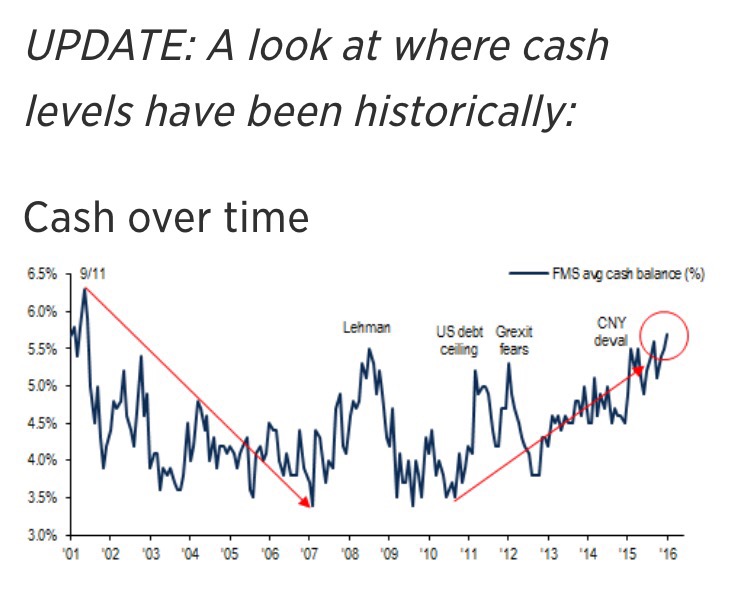
I found this chart to be kind of comical in the sense that it signifies almost nothing. Yet, it’s been cited by a big bank and it’s hit the CNBC newsfeed. Could a 2.5% swing in the level of current cash holdings in mutual funds mean all that much? Seems like an insignificant squiggly line to me. 

Who’s Afraid of a Fiduciary Duty?

June 10, 2016 by Jason P. Tank, CFA, CFP, EA

In this politically heated environment, yet another partisan battle ensues in Washington. It highlights a sad reality of how difficult it is to do what is so obviously right for consumers. In particular, the battle is over the concept that all investment advisors should adhere to a legal fiduciary duty to their clients when providing financial advice. Until very recently, this duty was largely followed by only a subset of financial professionals, registered investment advisors.

Viewed at a high-level, a fiduciary duty is simply the professional obligation to place the interests of the client first at all times and under all circumstances.

In many ways, the public’s ability to recognize a financial advisor acting as a fiduciary reminds me of that old legal definition of pornography – you know it when you see it. However, that doesn’t cut it when some in the financial services industry seem intent to blindfold the public. Amid a flurry of paperwork and small-print disclosures, most consumers are wholly ill-equipped and outgunned. That is precisely what industry regulation is designed to counter.

The quest to implore all financial advisors to operate under an obligation to act as fiduciaries has been the Holy Grail for as long as I can remember. Due to a massively powerful lobbying effort from those with a vested interest to avoid a legal obligation to first serve the interest of their customers, the foot-dragging among our regulators and politicians over the years was striking to watch. Finally, in April, the Obama administration took matters into its own hands.

Using the existing framework that imposes a fiduciary duty standard on financial advisors in their dealings with pension and employer-sponsored retirement plans, the Department of Labor simply expanded that same obligation to any professional who also provides advice to consumers who own an individual retirement account (IRA). In one fell swoop, that regulatory expansion brought almost every financial advisor into the fiduciary world. With a stroke of the executive branch’s pen, the last foot was dragged across the finish line.

Predictably and disappointingly, the House and the Senate – mostly along party lines -recently voted to strike down the new fiduciary duty rule. Obama’s veto last Wednesday successfully kept the rule in place.

In my view, despite the loss of a clear-cut competitive differentiator for me and my fellow registered investment advisors, the new fiduciary rule is a resounding victory for consumers. Let’s hope it survives our dysfunctional politics.

Understanding Your Investment Fees

June 5, 2016 by Jason P. Tank, CFA, CFP, EA

At the Front Street Foundation’s recent Money Series workshop, an attendee asked a deceptively difficult question. She wanted to understand how to figure out the cost of her investment program. That’s a simple enough request, right?

It should be easy for consumers to safely navigate the investment industry. Never is this more the case than it is today. Just last month, essentially every professional who provides financial advice must now operate under the same fiduciary duty rules independent registered investment advisors have always lived under. It is a long overdue and good change for investors.

Given this, my initial suggestion was for her to ask her current advisor what she’s paying. After all, it is a quick calculation for a professional to make and, now, it is her advisor’s obligation to provide her this information. Sadly, she didn’t trust her advisor to give her the straight scoop. She clearly has a larger issue to address, other than knowing the cost of her investment program.

I’ve been asked about fees often in my career and have helped calculate the fees paid by investors on countless occasions. Here’s a basic primer on how you can do it from the comfort of your own home.

For the typical investor who invest in mutual funds, grab your most recent brokerage account statement and go visit morningstar.com.

Each mutual fund you own has a unique ticker symbol. Find the ticker symbol on your statement and just enter it in the search box at the top of the website. Click on the resulting mutual fund’s tab labeled, Expense, and scan down the page for the words, “Net Expense Ratio.”

The net expense ratio is the all-in cost of your mutual fund, presented on a percentage basis. Simply take this percentage and multiply it by the current value of your mutual fund holding. Repeat this process for each mutual fund you own and, finally, add up all the fees. Yes, some math is required.

However, there’s more. If you have also hired an adviser to manage your investments, you are probably paying advisory fees too. Further, if you’ve chosen to work with someone who sells financial products for a commission, some deeper digging is required.

No consumer would dream of buying groceries, clothes or a plane ticket without knowing the price. It begs the question, why do so many do just that when it comes to their investments?

Jason P. Tank, CFA will present, “Understanding Your Investment Fees” at the Front Street Foundation’s Money Series on June 15th at 6:30pm in the McGuire Room at the Traverse Area District Library. Call (231) 714-6459 or visit FrontStreetFoundation.org, if you plan to attend. Front Street Foundation is a local nonprofit providing financial education for all people.

Spring Cleanup For Your Money

May 8, 2016 by Jason P. Tank, CFA, CFP, EA

It’s that time of year where you peer outside after a long winter and see an unwelcome amount of debris and disorder awaiting your spring cleaning efforts. The fortunate among us hire a cleanup crew. The planners among us pay attention to the friendly offer from the city to help haul it away for you. But, we’re clearly not all fortunate or planners.

While a nice looking yard is enjoyable, cleaning up your financial debris and disorder is far more important. Many people just never seem to get around to it. Let this serve as both a friendly reminder and an easy-to-follow starting guide.

As always, the most important step is the first one. Start by simply writing down your personal list of those nagging and long-neglected, money-related items in your life. But, be sure to keep it brief at first. People often craft an emotionally impossible list of things to accomplish. The result is entirely predictable; continued procrastination.

In the name of simplicity, craft your list into digestible bites that will allow you to move along the path to a simpler and more efficient financial setup. To begin, I will highlight three key areas you should focus on.
Start by taking a good look at your money mechanicals.

These are equivalent to digging out your dirty, outdoor furniture from winter storage or turning on your sprinkler system or taking your lawnmower in for that overdue tune up. If you ignore your mechanicals for too long, it gets awfully difficult to actually enjoy those summer moments. The same thing happens in your financial life.

I suggest an initial focus on three tasks and then move deeper from there.

Start by reviewing the inventory of your investment and financial accounts and taking special note of your current beneficiary designations for your retirement accounts and your life insurance policies.

Next, dig out your old, dusty, estate planning documents and make sure your former self’s thoughts are still valid and that nothing is worthy of a formal reevaluation.

Finally, have that short and important conversation with your spouse or loved ones about how they could actually access all of your accounts in the event you were no longer around. Write it all down on a single sheet of paper and keep it in a secure place. This simple step will absolutely save a lot of pain and inconvenience at a difficult time.

Together, these simple first steps will likely open up a world of profound thoughts regarding your financial affairs. Don’t let that scare you.

Slowing Earnings Growth

April 29, 2016 by Jason P. Tank, CFA, CFP, EA

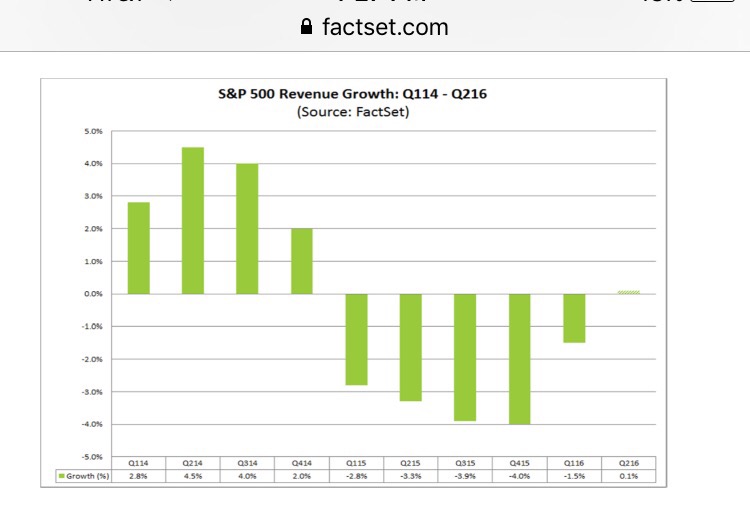
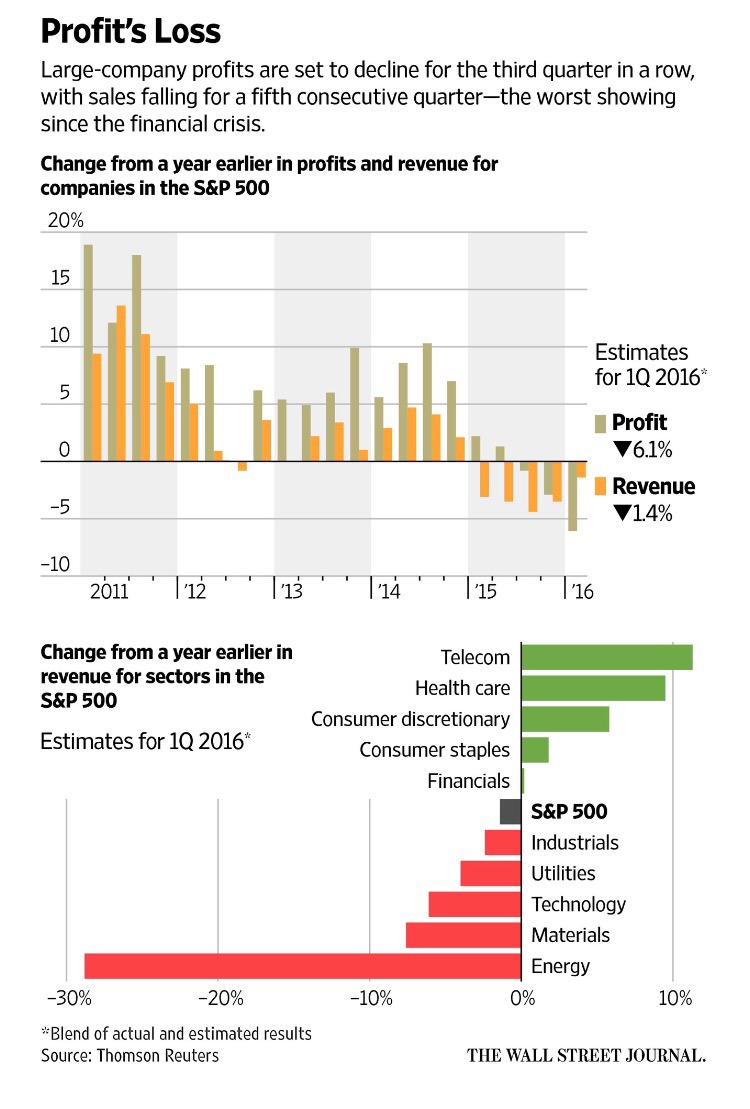
Here’s a picture of the slowing growth phenomenon that’s now turned into a three or four quarter negative trend.

Yes, the energy sector is a big part of the profit and revenue drag, but the earnings flatline has been far broader than just a single sector of the economy. This has certainly impacted Fed policy and has created a pause in investor optimism.

With the recent GDP print of 0.5% in the first quarter of 2016, on the back of only 1.4% annual growth at the end of 2015, a bit of investor anxiety is warranted. This is especially the case after a roughly 15% rebound in stock prices over the past two months.
slowing earnings growth

Yes, Fiduciary Duty Matters

April 6, 2016 by Jason P. Tank, CFA, CFP, EA

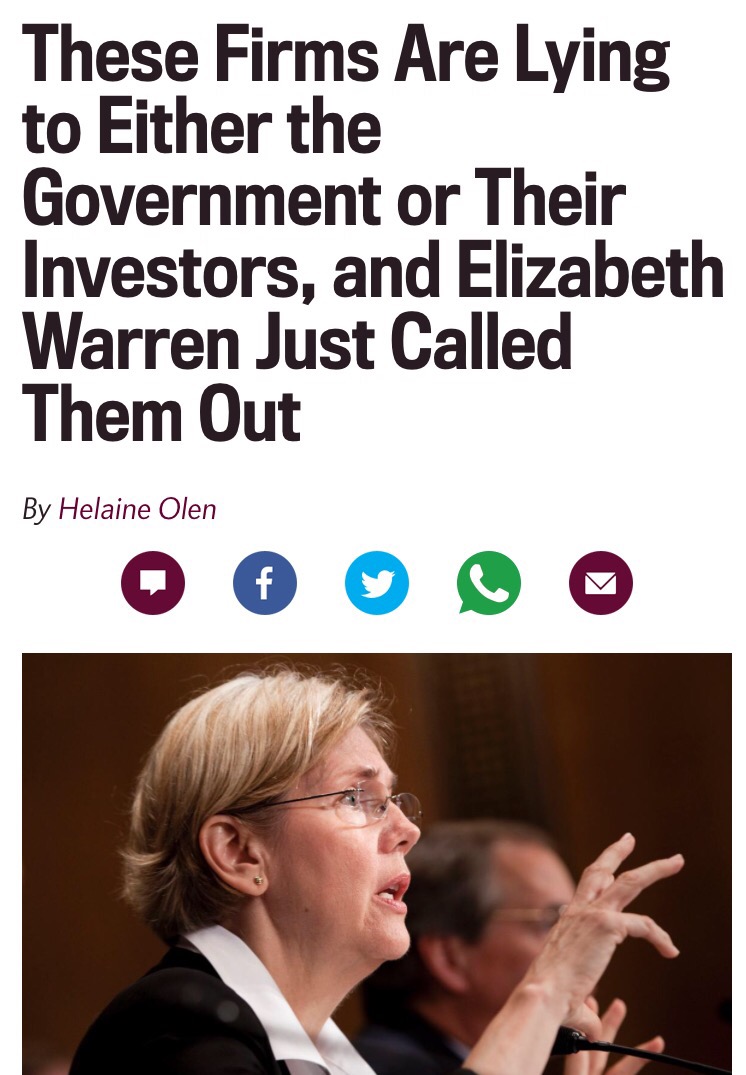
Senator Elizabeth Warren is onto something with her recent letter to the SEC about fiduciary duty.

As a fee-only, fiduciary-bound investment adviser, I wholeheartedly agree that my clients’ interests should always be placed ahead of other competing interests.

This fiduciary duty mindset is not universal in my industry.

In too many circumstances, advisers who hold themselves out as financial service providers for their clients are not duty bound by a fiduciary obligation to their clients.

Instead, a certain subset of professionals in the financial services industry are held to a simpler and, I believe, lower, standard of “suitability”, rather than a fiduciary duty.

In other words, many non-fiduciary duty bound advisers only need to offer products and services that are only just suitable enough for their clients.

Following this suitability standard may invariably lead to higher compensation to them or their firms and higher costs to their clients. That’s okay, as long as what’s been offered to them is suitable enough.

In contrast, the fiduciary-bound adviser has a higher hurdle to leap in their dealings with clients and the public.

In the linked article, Senator Warren is right to point out the contradictory statements of some companies in the financial services industry.

My belief is that all advisers should uphold and practice as fiduciaries to their clients. Investment advisers, like my firm, are required by law to be fiduciaries at all times and under all circumstances when they provide services to their clients.

It’s simple to do and, more importantly, simply the right thing to do.

Click image to read…

Fiduciary Duty Matters

Self-Defeating Fed Speak

April 4, 2016 by Jason P. Tank, CFA, CFP, EA

After reading dovish remarks from Fed chair Janet Yellen last week, these comments from another Fed governor stand in stark contrast. 

It begs the question if the Fed believes that its primary tool is its ability to manipulate expectations for interest rates in the future through the power of its words, this type of cross-talking between officials certainly doesn’t help in that policy tool. 
Rosengren to markets: You have it all wrong on rate hikes http://www.cnbc.com/id/103518094

Resting Hopes on Central Bankers

March 31, 2016 by Jason P. Tank, CFA, CFP, EA

After yet another violent market swoon and snapback, it is entirely possible investors are resting their hopes on a flawed belief.

The first quarter of 2016 displayed a range of emotion that could shake even the most rational of investors.

The first six weeks of 2016 saw stocks rapidly decline, at one point down around 10% to 15%. While the depth of the decline could reasonably be described as normal, the speed was certainly sudden. On the flipside, the market’s recovery over the second half of the quarter has been equally quick.

Today, in fact, most stock market indexes now hover around the zero line year-to-date. No gain and only the fading memory of pain.

It was quite a ride that no doubt favored investors who were either blind or deaf or internet-free, as it has since the recovery began in 2009. Contemplation and preparation has not been rewarded.

To begin the year, investors began anticipating the negative effects of the Fed’s move off of zero interest rates. That concern, coupled with the fact that the economy is still showing only subdued growth and corporate profits have been in decline, investors were quick to cry wolf.

As soon as their cries rang out, central bankers in Europe, Japan and China all responded with more easy money. In fact, describing it as easy money may be an understatement with a large portion of all government debt across the globe now trading at negative yields. Yes, unbelievably, negative interest rates require the investor to pay the borrower for the privilege to lend!

Following suit, our own central bank has consistently backed down the expectations for rate hikes this year and next.

It’s almost ironic that the Fed started to raise rates in December, citing a healthy enough economy to start “normalizing policy”, as they say. Now, growth has stalled out once again, as it’s done repeatedly.

Regardless, my observation is investors don’t care as much about economic growth or even profit growth as they do about the underlying support of central bankers.

The quick market bounce in mid-February almost perfectly coincided with a doubling down of promises of lower rates for longer and more asset purchases around the globe.

Investors reaction to promises of easy money reminds me of the long held belief that objects of different weight – a bowling ball and a feather – fall at different rates.

For thousands of years, this flawed belief was seen as an universal truth by the academic elite. That is, until Isaac Newton showed what other non-academics knew long before, all objects are affected by gravity just the same.

Are investors simply buying into a similarly flawed and long-held belief that central bankers and low rates will always be there to rescue them? We shall see, but I’m placing my bet on gravity.

Time to Tidy Up Your Finances

March 21, 2016 by Jason P. Tank, CFA, CFP, EA

The recent best-selling book, The Life-Changing Magic of Tidying Up, argues that life’s better when you eliminate your clutter. I believe the exact same principle applies to your financial life.

As you look at your pile of shoes, tools or warily peer into your messy closets, it’s no surprise your things get lost so easily. Too often, partially due to a distaste for all things related to money, people similarly neglect their finances.

If this describes you, your benign neglect may lead to costly and avoidable mistakes.

Over the years, I’ve noted two common habits that lead to financial disorder.

First, many people have too many investment accounts. It results in a cornucopia of accounts and the situation is overwhelming.

This type of shotgun approach – to just open accounts all over town and never look back – creates a situation that is often unmanageable for a normal person. And, as a general rule, what is unmanageable most often remains unmanaged. In the world of investments, I can assure you, that’s not a good thing.

People living in this disorganized state also have little idea about their overall investment allocation and the level of risk they are taking with their money. With their piles of unopened envelopes and email notices growing, they often don’t know their mix of stocks, bonds or cash. There are simply too many accounts and it literally stops them from moving forward with a strategic investment plan.

Second, failing to periodically clean out your financial closet can result in costly estate and tax planning mistakes.

For example, neglect can lead people to fail to update their beneficiary designations as their life situation changes, such as a divorce, death or having a new child. The benefits of good tax planning concerning your heirs can be large and to inadvertently throw them away is unfortunate, to say the least.

Another example is for those who have successfully completed basic estate planning moves – through the creation of trusts or other methods. Having to keep track of too many moving parts naturally lead to a failure to execute on the plan. When you don’t actually fund your trusts or properly designate your payable-on-death directives for your various accounts, all the planning in the world is wasted effort and can lead to avoidable expenses for your loved ones.

A good financial adviser will work to better organize your financial life. Helping you tidy up your affairs is one of their core functions to help you gain confidence with your overall financial strategy and plans. An uncluttered home – and an uncluttered financial life – invariably leads to an uncluttered mind. It might even feel, dare I say, life-changing.

Investment Costs Add Up

March 10, 2016 by Jason P. Tank, CFA, CFP, EA

Occasionally, I experience disappointments as an investment adviser. It comes with the territory as I get to see behind the curtain of the financial services industry. It saddens me to report, when it happens, it’s often not a pretty sight.

An individual recently came to me for advice about his IRA account. After years working with an adviser, his gut told him he needed another set of eyes to take a look. His hunch was right. In a nutshell, the investment expenses he was paying were outrageously high.

The primary lesson is, you should periodically conduct your own review. It’s not difficult to do. The savings you might find can add up to a substantial sum over time.

Casting the curtain aside, here’s what I saw.

First, this individual’s adviser charged him 1% of his account value per year for services that largely focused on investment management. He described to me a relationship that was very light on personalized financial planning. For that 1% fee, which isn’t uncommon, the delivered services shouldn’t be light on this front.

But, as they say, there’s more.

Next, his adviser chose to outsource his duties to another investment advisory firm. Outsourcing is also not uncommon in my industry, especially for advisers who either don’t have the professional skill or the inclination to actually manage their clients’ assets themselves.

However, as a prudent consumer, you should be very aware of the possible double-layer of expense an outsourcing decision creates. In this individual’s case, his adviser’s outsourcing added yet another cost of 1.25% per year.

Unfortunately, as bad as this might be, you guessed it, there’s more.

 Third, the outsourced investment adviser outsourced his work too. As part of their service, they chose to invest the money in various mutual funds that, together, added at least 0.75% per year in additional costs.

With the curtain fully drawn back, this individual incurred total expenses of roughly 3% per year. Expenses like these create a hurdle so high, few investors can ever get ahead. And, these expense layered cakes are not rare enough, especially for smaller investors who can afford them the least.

 Think about the math for a moment. With interest rates so low today and with the economy now entering its eighth year of recovery, future investment returns – after expenses like these – may indeed have a hard time staying in positive territory.

Learning how to analyze your investment costs is a skill worth developing.  

Comments on Buffett’s Annual Letter

February 27, 2016 by Jason P. Tank, CFA, CFP, EA

Just finished reading the letter portion of Warren Buffett’s annual report to shareholders. It’s always a good read.

My general impression is that Buffett is increasingly describing the wide-ranging operations of Berkshire in terms and structure that highlight the conglomerate his empire has truly become. The specifics of the many underlying, smaller businesses that Berkshire controls and the investments Berkshire makes in marketable securities, are largely gone from his commentary. This was once the bread and butter for professional investor readers. This is natural and reflects the sprawling nature of the business today. Still, his letter does lose a little bit of its “nerdiness” as a result.

It was noticeable to me that he used only one page – just a short list – to describe Berkshire’s investment activities and he made no detailed mention of bonds (a big part of Berkshires’s portfolio as a large insurer), the state of the economy or the current state of central bank policies that have produced unprecedented effects in financial markets today. His comments about the market and their transactions along the way were very sparse and no real mention was made of his investment lieutenants’ (Combs and Weschler) decision making or returns in 2015. Given the focus that many shareholders place on Buffett’s investment acumen, I found this somewhat odd. Especially so, given that he is 85 years old.

Overall, the businesses that Berkshire controls have certainly produced a very diversified set of income streams. The overall value of the company, from a book value relative to its current market value perspective shows that Berkshire’s common stock is reasonably priced at around 1.2x book value. In fact, this is the valuation level that Buffett has stated will prompt him to use Berkshire’s resources to buy back its own shares. This has not occurred often in his 60 year history.

My opinion on Berkshires’s lower book value multiple is that it better reflects the reality that a management transition will occur sooner rather than later. Given its complex conglomerate structure – again, one highlighted by this year’s letter – Buffett’s successors will have a challenge during a transition.

Election Issue: Social Security Reform

February 25, 2016 by Jason P. Tank, CFA, CFP, EA

In the high heat of this election cycle, Social Security reform will likely slide closer to the front burner. If not, it should.

As an investment adviser who disproportionately works with near- or currently- retired people, I see firsthand the important role Social Security plays in their overall financial picture.

For a large proportion of retirees, Social Security represents the majority of their retirement income. For this reason alone, digging into our presidential candidates’ Social Security reform proposals is a high priority.

Bernie Sanders appears to provide the most detailed Social Security reform proposals on record. Naturally, he focuses on increasing the program’s funding to help shore up its long-run financial sustainability.

Sanders primarily proposes raising the cap on wages subject to payroll taxes earmarked for Social Security. Under his plan, today’s maximum threshold of around $120,000 per year in earnings subject to this tax would remain. His new proposal is to restart collecting the payroll tax once a worker’s earnings exceed a new threshold of $250,000.

Importantly, in exchange for these additional contributions, affected taxpayers would receive no additional benefits and the money raised would be used to support the benefits of those with a lower history of earnings.

Hillary Clinton’s proposals center on her opposition to retirement age hikes, privatization plans or payroll tax increases for the middle class. Clinton has expressed openness to Sanders’ idea of raising the cap on earnings subject to Social Security payroll taxes, but provides no specific plans.

Donald Trump’s main idea for Social Security is to produce faster economic growth. However, I am not aware of an analysis of how economic growth affects the long-run financial position of Social Security. Beyond the economic growth argument, Trump has also suggested that wealthy people voluntarily return their benefit checks and that he’d reduce “waste, fraud and abuse.”

Marco Rubio and Ted Cruz both support increasing the retirement age and lowering the inflation rate for benefit payments. Both also support the idea of younger workers developing private accounts within the system.

While Cruz’ plan for privatization appears similar to Bush’s previously failed attempt, Rubio’s private account proposal appears to be designed as a supplementary source of retirement savings, rather than a replacement for Social Security.

Social Security is the ultimate political hot potato, no doubt. Understanding the candidates’ reform proposals – with details that allow for deeper analysis and thoughtful debate – is a basic right of voters. The goal of any reform, as I see it, is to reach a collective view on how we’ll maintain Social Security as a pillar of financial support to the millions of retirees who need it. Benign neglect won’t get the job done.

Jason P. Tank, CFA of Front Street Wealth Management will hold a free educational workshop on “Navigating Social Security’s New Rules” on March 9th at 6:30pm in the McGuire Room at the Traverse Area District Library. Call (231) 714-6459 with questions, visit frontstreet.com/workshop to learn more.

Battle Plan for Investment Volatility

February 16, 2016 by Jason P. Tank, CFA, CFP, EA

Download Presentation


Stock markets are down this year between 10% and 15% across the globe. From their recent highs set in 2015, the drop has been an even larger 15% to 30%. Now is a good time to talk battle plans for handling this type of investment volatility.

While investment battle plans are best established prior to declines, it’s never too late and today’s lessons will no doubt help you tomorrow.

Your first line of defense is to do an investment risk assessment.

A proper risk assessment is a function of your age, income, assets, debts and your lifestyle desires. Together, these factors define your financial capacity for taking risk. It’s the brains, but not the heart of the matter.

A clinical exercise in financial accounting just isn’t sufficient to capture the power of your emotions. While investment advisers tend to denigrate investors’ emotional decisions, let me provide you with a more-nuanced view.

Like it or not, your emotional tolerance for risk will always be a part of you. Discounting who you are is generally a futile fight. Given this reality, your focus should be on properly aligning your portfolio’s high-level structure with your tolerance for taking risk. If you don’t know your portfolio’s asset allocation, review it now.

Your next line of defense is to actually know what you’re invested in.

If you own mutual funds, like most people, you should work to understand the investments sitting inside those funds. Remember, a mutual fund is just a box with wrapping paper on it. What’s inside is what matters most. If you don’t know the type of funds you own, find out.

Your third line of defense is to be diversified.

Diversification is often cited by investment advisers. Sure, it’s good, classic advice; don’t put all your eggs in one basket. But, calling it good after simply noting a long list of holdings on your account statements may open you up to some hidden risks.

Ask yourself if your portfolio is hanging on a common thread. For example, in your search for income in a yield-starved world, do you own too many real estate funds, lower-quality bonds or even safe-looking bond funds that rely on leverage?

Upon deeper analysis, you may have exposed your portfolio unknowingly and are actually undiversified. After all, diversification is not about how many investments you own. Rather, it’s about the commonalities and differences between them. If you are unaware of the factors that affect your portfolio, I’d suggest you start doing your homework

Jason P. Tank, CFA of Front Street Wealth Management will hold a free educational workshop on “Battle Plan for Investment Volatility” on Feb 24th at 3:30 pm in the Blue Room at the Traverse Area Chamber of Commerce. Call (231) 714-6407 with questions, visit frontstreet.com/workshop to learn more.

Retirement Income: From Where & When?

February 3, 2016 by Jason P. Tank, CFA, CFP, EA

Download Presentation

One question has rung through loud and clear following my two recent columns on the big rule changes with Social Security and the development of a safe spending rate in retirement.

Soon-to-be and current retirees want help developing a holistic plan for the “living off my savings” phase of their retirement journey.

Specifically, their burning question can be broken down into three smaller questions. First, from which accounts should we withdraw our money and in what order? Second, how exactly will my Social Security benefits affect our tax bill? Third, what steps could we take now to help minimize our tax bill in retirement?

Our financial system is a ridiculously complex maze for retirees to navigate. At the center of the complexity sits our tax code.

Regarding the question of which accounts should be drawn from first and in what order, most retirees have two forms of savings. They have savings that have already been taxed and savings that have yet to be taxed.

To begin, it’s important to understand that the mere act of drawing from your already-taxed savings does not trigger a tax bill. Only your dividends, interest and realized gains result in tax payments. In contrast, the act of drawing from your tax-deferred savings creates immediate taxable income.

Given this, choosing the best source of retirement income clearly depends on your own tax picture. For this reason, sound advice about the best source of retirement income wholly depends on your personal financial setup. This requires some basic tax modeling of your present and future tax picture.

Next, you may not realize that Social Security benefits are often taxed. The proportion of this benefit that is taxed can range from none to a maximum of 85% of the benefit. The tax owed depends entirely on your other income, some of which is voluntarily created by drawing from your tax-deferred accounts, such as your IRAs.

With this understanding, the decision of which pot of savings to draw from – your already-taxed savings or your tax-deferred savings – can impact the amount of tax owed on your Social Security.

Finally, there are planning techniques that might allow you to minimize your future tax bills in retirement. Among these techniques are strategic, partial Roth IRA conversions and the possible utilization of the 0% capital gains tax rate on your federal tax return.

Intelligent planning for the “living off my savings” phase is increasingly on the minds of current and soon-to-be retirees alike. The educational steps you take now will no doubt pay dividends later. Best of all, those dividends are completely tax-free!

Jason P. Tank, CFA of Front Street Wealth Management will hold a free educational workshop on “Retirement Income: From Where & When?” on Feb 10th at 6:30pm in the McGuire Room at the Traverse Area District Library. Call (231) 714-6407 with questions, visit frontstreet.com/workshop to learn more.

Central Bankers: They’re Back Again

February 1, 2016 by Jason P. Tank, CFA, CFP, EA

Global central bankers are back at it again!

With Mario Draghi at the ECB talking about revisiting their policy in March – a code phrase for potentially increasing their current quantitative easing policy – along with Japan’s central bankers actually beginning to charge their banks 0.1% on excess reserves, it appears global central banking is taking its next step on the path to total manipulation of their respective economies.

Now, the Fed truly stands alone. Will the Fed pause and reverse itself if markets continue to waiver? Will such a reversal even matter? The burning question is whether or not monetary policy had lost its grip on markets.

Finding Your Safe Spending Rate

December 31, 2015 by Jason P. Tank, CFA, CFP, EA

More goes into planning for and sustaining a retirement than meets the eye. On the surface lies plenty of generic advice from the financial planning industry. Yet, beneath the surface are a slew of assumptions about a largely unknown future. To understand how to manage your sustainable retirement clearly takes more than simple rules-of-thumb.

It should come as little surprise that your retirement decision may be dominated as much by feelings of insecurity as it is by feelings of excitement. Thankfully, the balance between these two emotional poles can be tilted in your favor with pre-retirement planning.

For example, one critical first step for a soon-to-be retiree is to develop a deeper understanding of your post-retirement budget. During your working years, budgeting is all-too-often dismissed. However, when your income becomes more-fixed and less-active in nature, spending choices take on a new sense of importance.

During meetings with soon-to-be-retired clients, my early fact-finding focuses on gaining a better understanding of the true cost of their lifestyle. Without that understanding, retirement planning – and the day-to-day services that follow from that planning – can feel like stumbling in the dark.

With your lifestyle’s financial obligation defined, the traditional survey of your assets and debts and the review of your various sources of income begin to take on the deeper purpose of building financial sustainability.

Of course, the financial obligation that springs from your choice of retirement lifestyle must be met by sustainable income. For most retirees, at the base rests Social Security and, for a shrinking number, pension income. Together, these are just two legs of the proverbial three-legged financial stool.

The final leg of a sustainable retirement is built from income earned from your personal savings. While some might be generated from real estate or even business interests, it often must be earned from traditional sources, such as IRAs or after-tax savings and investments.

It is here, within this portion of private savings, where you may have a lack of confidence of how much you can safely spend from private savings each year.

This central question about your safe spending rate, known in the industry as the sustainable withdrawal rate, is where financial planners toss around overly-simplistic rules-of-thumb. In reality, the assumptions that underpin rules, like the “4% Rule”, are complex and debatable. For good reason, this subject dominates the thoughts of many financial planners. Honestly, it rarely strays far from my mind when managing my clients’ investment portfolios.

As we enter the new year, it would be wise for you, a current or soon-to-be retiree, to establish your own personalized safe spending rate. Only then will a confident retirement – and, yes, a worthwhile New Year’s resolution – be sustained.

Jason P. Tank, CFA of Front Street Wealth Management will hold a free educational workshop on “Finding Your Safe Spending Rate” on Jan 13th at 6:30pm in the McGuire Room at the Traverse Area District Library. Call (231) 947-3775 with questions.

Interest Rates to Rise Slightly

December 18, 2015 by Jason P. Tank, CFA, CFP, EA

The Fed did it! After nine years since the last rate hike, and following seven years of near zero interest rates, the Fed and Janet Yellen last Wednesday finally raised short-term rates by a whopping one quarter of one percent. The financial markets, which had been displaying concern and worry during the decision’s build-up, largely sloughed it off.

Listening to Yellen during her follow-on press conference, what strikes me is the Fed’s propensity to represent the consensus view. As economic cheerleaders, this is quite natural for the Fed, of course. What else could they say and how else could they feel other than believe the near-term future will resemble the recent past? The past trend is always the future trend to consensus thinkers. This is precisely why the majority of investors fail to anticipate a change in the trend.

For example, as the calendar turns, many will read market prognostications for the year ahead. Already I have noticed news stories that indicate stock market returns will be in the range of 5% to 10%. For as long as I can remember, I’ve seen this range of returns anticipated time and time again. Not coincidentally, that range fits the long-term historical return of stocks in the US.

Published along with the news release of the Fed’s decision last Wednesday, Fed governors made public their own individual projections of economic growth, inflation expectations and unemployment over the next few years along with their long-range expectations of these same measures. What’s striking about this report is their consistent lowering of economic growth and inflation relative to their prior projections. The Fed has consistently been too optimistic.

Like many economists and investors, the Fed has looked for inflation to rise back to its long range target of 2% per year. Today, that measure sits closer to 1%. The consistent undershoot of inflation is not a phenomenon of the US alone. Many of the largest economies in the world are also experiencing what’s known as disinflation – a decrease in the rate of inflation. This was true prior to the drop in oil prices and does raise questions about possible structural issues for the global economy that may lead to continued subdued inflation rates.

It’s fair to say that the largest concern of all central bankers is for disinflation to morph into deflation – that is, an outright drop in prices. This is what Japan struggles with today following their own financial crisis many decades ago. Global central bankers, through zero interest rates and asset purchases, responded to this prospect with an unparalleled monetary experiment.

The question is, did the experiment work? With the Fed finally raising interest rates off the floor, the largest impact may be in the confidence “signaling” impact for investors. In other words, if the Fed feels it’s safe to finally raise rates after seven years in credit crisis-recovery mode, they must feel the trend is their friend. Outside of asset price appreciation and a now-larger pile of low-cost debt, a definitive answer to the question remains unanswered.

Social Security New Rules – Part II

December 13, 2015 by Jason P. Tank, CFA, CFP, EA

In this second segment of in my series on the new rule changes within Social Security, I will delve into other aspects worthy of deeper analysis.

Where my previous column highlighted the late April 2016 deadline faced by a 66 year-old couple planning on using Social Security’s “file-and-suspend/restricted application” trick to maximize their benefit, this week focuses on how the new law affects two younger demographic groups; those age 62 to age 65.5 and those younger than age 62.

Over the next four years, Congress is winnowing down the filing options that Social Security now offers. As time passes, the available choices for retirees will become fewer and fewer. The upside of this narrowing of choices is the beauty of simplicity for future retirees. The downside, as you might have guessed, is your Social Security benefits over your lifetime will likely be less than those received by the prior generation.

To begin, if you won’t reach age 62 by the end of this year, you will not be allowed to restrict your filing to just your spousal benefits. If you fall into this younger group, Social Security will simply pay you the greater of your own earned benefit or the benefit you’re entitled to receive as the spouse of another then-collecting worker.

With these simplified rules, for the youngest among you, Congress just took away your ability to begin collecting your spousal benefit – which can begin at age 66 – while also simultaneously deferring the benefit you may have earned yourself. That “restricted application” trick is over for you.

This ability to collect only your spousal benefits – and watch your own benefits based on your work record grow year after year after year – is now only available to those who are at least age 62 by the end of 2015.

For this slightly older group – let’s call them the middle demographic – you will still have the right to collect your spousal benefit at your full retirement age, to continue to let your own benefit grow 8% per year until age 70 and then, finally, to switch over to your bigger benefit. But, there’s a catch to remember with this strategy.

Unlike the older retirees profiled last week, for this middle demographic to be allowed to restrict their filing to only their spousal benefit, their spouse must also be collecting their own benefit.

With deadlines approaching and with the key role Social Security plays in retirement income planning, understanding the rules has gained importance.

Social Security New Rules – Part I

November 24, 2015 by Jason P. Tank, CFA, CFP, EA

There is yet another financial planning deadline looming on the horizon. Congress was nice this time as this newest deadline occurs when the snow melts by April 30, 2016. Nonetheless, time seems to move at an accelerated pace and May will be here before you know it. For that very reason, planning around the latest rule changes regarding Social Security is something to act upon well before then.

To begin, Social Security presents complexities that are not fully recognized by most people. Many retirees consider Social Security a benefit that is simply started at a particular age. Most commonly, surprisingly, people apply at the earliest eligible age of 62. In fact, almost half file for benefits at the earliest moment possible and, as a result, accept a permanent 30% reduction in benefits for life.

On the other hand, some people plan extensively to maximize their Social Security benefits. The latest law changes – hot off the presses – significantly affect their well-laid plans. These people should bone up now on the changes as Congress has set a clock that’s ticking down.

For background, the most classic Social Security maximization strategy is one used by dual-income couples. The strategy goes something like this, assuming a same-age couple.

The higher earning spouse – let’s say it’s the husband, in this case – files for benefits at age 66 and then immediately suspends his Social Security benefit. This move is called, file-and-suspend. During his benefit suspension period, his eventual benefit will grow 8% larger for each year he waits to collect – until he hits age 70.

Now, because he formally filed for benefits, his wife is entitled to receive her spousal benefit equal to 50% of his benefit amount, even if he’s chosen to not collect his benefit. All spouses are entitled to receive this 50% benefit. In this example, she is not filing to receive the benefit she’s earned through her own lifetime of work. Instead, she’s only choosing to receive her likely smaller spousal benefit. This move is called, filing a restricted application.

The trick is, while she’s collecting her smaller spousal benefit, her own eventually larger benefit – the benefit that’s based on her work record – will continue to grow 8% per year, until she too reaches age 70. For dual-earning couples, this strategy works to maximize their Social Security benefits.

And, here’s the punchline, this strategy – for those who haven’t already put it in place – will end on April 30, 2016, unless they act by then.

Of course, the myriad of Social Security claiming strategies are nearly endless and deserve individualized analysis. In future columns, I will address additional situations affected by the recent law changes. Change is clearly a rule and Social Security’s new rules are no exception.

Jason P. Tank, CFA will hold a free public educational workshop on this topic on December 9th at 6:30pm at the Thirlby Room at the Traverse Area District Library.

No Holiday From Financial Tasks

November 3, 2015 by Jason P. Tank, CFA, CFP, EA

As part of my series on end-of-year financial tasks, there are a few deadlines that many people need to pay attention to as they do annual planning with their investment advisors and other consultants.

I’ll highlight one in particular that is of extreme importance for many senior investors. I’ve discussed this in past columns, but it bears repeating given the onerous penalties you face if you do not comply with the law.

Once you reach age 70 1/2 and forevermore, you face what is referred to as a “required minimum distribution” from your IRA accounts. Like too many things, this one goes by an acronym of RMD. Essentially this is your annual requirement to withdraw a certain minimum dollar amount from all of your tax deferred accounts.

The logic behind this is the government wants to finally collect its take on the money you’ve put away and invested free of taxes. Their required minimum distribution rule assures the tax is paid.

If you don’t comply – whether or not your neglect is completely benign – the penalties are extraordinarily harsh. They can total 50% of the expected annual distribution. Please don’t forget. With penalties like these, a double-check is just a smart policy.

Typically, after your first required minimum distribution has been processed by your account custodian or brokerage firm, the subsequent distributions from your tax-deferred accounts will become automatic. This lessens the burden placed on you to remember each year.

However, your first distribution must be set up manually either with your advisors help or by you if you are a do-it-yourself investor. It’s often this first year where an oversight can occur.

While it should be simpler than this, there are a few nuances with required minimum distributions that are worth discussing further.

The first involves people who may have inherited an IRA from a non-spouse loved one. In this case, the required minimum distribution rule can be much more burdensome. With Inherited IRAs, the custodians or brokerage firms often do not set up an automatic process in subsequent years as they do for non-inherited IRA account holders. Therefore, Inherited IRAs require some extra care.

In my experience, the prospect of forgetting to take an annual distribution occurs with situations of Inherited IRAs. To minimize the risk, my advice is to speak to an advisor the moment you inherit an IRA.

In addition, in the year in which you turn 70 1/2, there are special rules regarding the required timing of the first annual distribution. To discuss the benefits of this special first-year rule, it may require a personalized conversation with your investment advisor and your tax consultant to help craft the most tax efficient strategy.

As is often the case in life, the busiest times of the year, such as the holidays, often inconveniently correspond with some of the most important times of the year to review your financial situation. There’s simply no way around it, no matter how much you and your advisers would love to have the ability to turn back time!

The Season for Financial Planning Strategies

October 16, 2015 by Jason P. Tank, CFA, CFP, EA

It’s the season to do some year-end financial planning. If you haven’t spoken with your adviser in a while, this may be a great time to engage in a conversation about any changes in your financial life.

Throughout my career I’ve seen a number of opportunities lost due to a lack of coordination between clients’ many different advisers. Please don’t let this happen to you.

To prod you forward, I recommend you first review any major changes in your financial life during 2015. For example, did you incur unusually large medical expenses this year? Have you sold something that resulted in an extraordinary gain or loss? Has your income increased considerably? Or has it possibly decreased due to a job loss or job change? The list of possible changes in your life is vast.

With this information in hand, there are many opportunities to save money. Unfortunately, many are connected to a deadline of December 31 involving our overly-complex and often unforgiving tax code. It’s clearly too much for a normal, busy person to follow. Therefore, if you’ve engaged advisers for your investments, tax planning and legal affairs, encouraging a coordinated level of service can work wonders.

For example, do you know that federal capital gains are taxed at a 0% rate if your taxable income falls below the 15% federal tax bracket threshold? If you are sitting on unrealized capital gains from years worth of gains, you may be able to take advantage of super low capital gains taxes in a year in which you earn less than typical.

In addition, if you are able to show less taxable income this year than normal, it may be intelligent to consider a partial Roth IRA conversion from part of your regular tax-deferred retirement accounts. Of course, the analysis required for Roth conversions is not simple and does involve making a reasonable set of assumptions about the unknowable future. Doing that analysis is a smart move.

Another possible retirement savings strategy is available to self-employed individuals who have the desire to save more and pay less tax today. If you qualify, a high-earning small business person can save much more through a little-known vehicle called an Individual 401(k) than they can through a regular IRA. Unlike a regular 401(k) plan for a small business, these special use 401(k) plans are not complex or costly to set up or maintain.

However, if you don’t make the right moves with this information by December 31, you stand to miss out on these planning opportunities and more. As the famous Nike ad once said, just do it – before the busy holiday season. Amazingly, it’s once again just around the corner.

There’s Value in Warning Signs

October 5, 2015 by Jason P. Tank, CFA, CFP, EA

The Chinese panicked, stock markets around the world choked and the Fed blinked. What a quarter it was, replete with swings only a die-hard baseball fan could enjoy.

After a 6% drop in broad US market indexes, is this just the beginning of a deeper decline or only a long-awaited, run-of-the-mill correction with continued gains ahead?

It’s true, some headline data describes an economy that is still growing. Following a weak first quarter affected by the cold, the government’s official guess for the second quarter showed nearly 4% growth. The unemployment rate is down to almost 5%. Inflation, excluding energy prices, is still well below the Fed’s arbitrary 2% target. And, with rates low, auto and home sales are doing just fine. All in all, the view from 30,000 feet looks fine enough.

Now, to the on-the-ground view. We all know financial markets don’t operate on how things appear today. Instead, they focus on that never-to-arrive and always-uncertain, tomorrow. Given this, I think markets are flashing yellow warning signs.

First, risks are rising in lower-rated corporate bonds. Lower-quality bonds have declined about 5% in short order. This is raising concern among investors as weakness in junk bonds has traditionally been a leading indicator for periods of weak stock markets.

Next, stock prices are way down for companies most sensitive to cyclical economic shifts, such as industrial companies, big-ticket equipment manufacturers, commodity- and basic material companies as well as transportation companies. Compared to the market as a whole, these sectors have felt a much bigger brunt of the recent market downdraft.

In the midst of this under-the-surface activity, what’s catching my eye?

To begin, despite the uncertainty in the oil and gas market, I feel strongly there is value to be found in the massive carnage. Choosing even among the blue chip companies, such as Exxon Mobil, investors can benefit from large dividends at today’s low prices.

Next, there are a number of financially-strong industrial companies, such as Dow Chemical, that actually benefit from low energy prices. At a 4% dividend yield today, Dow provides the type of income that helps to battle this inhospitable rate environment. In addition, companies in the midst of corporate transformations, like Alcoa, offer good prospects. I also see tremendous value in a much-improved General Motors that currently pays a dividend of almost 5%.

Lastly, many blue-chip tech companies are just flat-out bargains today, in my view. With huge cash piles and serious earnings power, I think companies like Apple, Cisco and Microsoft are too hard to ignore for long-term investors.

Now, if the current yellow warning signs turn into bright red stop signs, you should also fully expect to see bargains go lower still. That’s the way markets work, of course, so please be sure to diversify and use common sense.

I do believe a change is afoot in markets today. Navigating it is going to require skill and investors might just want to get re-acquainted with seeing some red figures in their quarterly statements. If managed properly, for the prepared investor, yellow and red are not colors to be ignored or to be feared.

First and Second Level Thinking

September 17, 2015 by Jason P. Tank, CFA, CFP, EA

Regular readers know I often express myself in tones of varied skepticism. While I admit this tendency comes naturally to me, you should know it serves a deeper purpose. Let me briefly explain.

There is something inherently comforting when things sit in a state of balance. In investment markets, however, things are constantly in a state of flux, to one degree or another. Given this, an intelligent investment management process is often lonely and rarely involves broadly following the crowd. Skeptical investors love to ask questions and test the consensus view.

Influential investor and market thinker, Howard Marks of Oaktree, recently wrote about what he refers to as first-level and second-level thinking. His memo did a nice job of highlighting a concept that helps to explain why I feel a healthy sense of skepticism is beneficial as an investor.

First-level thinking tends to reflect the obvious facts already in the news. China’s slowing, commodity prices are down, sell oil stocks, avoid multinational companies and own the US dollar. With gas prices so much lower now and with interest rates still so low, buy consumer-oriented stocks that cater to domestic shoppers.

Now, a second level thinker, in reaction to a first-level thought, might sound very different. Yes, energy and commodity prices are down a ton and it does look like China is headed toward a rough slowdown. But, US oil and gas producers are busy lowering their costs and are finding ways to innovate. With their stock prices down so much and – as long as their balance sheets can hold up – I think they’ll make it through this down cycle. These companies might now be trading at bargain levels.

First level thinkers tend to feel more confident with validating information. It creates a comfortable emotional feedback loop as it follows a seemingly, logical, straight-line relationship. As their confidence builds, they seek safety in the crowd. Soon, ever larger numbers of investors adopt the same comforting view. And, over time, it becomes the consensus view of far too many investors.

The second-level thinker can appear allergic to the consensus view of the day. As uncomfortable as it can feel, second-level thinkers know that following the consensus is not how money is made or how losses are avoided in investment markets. Actually, just the opposite tends to be true over time.

Second-level thinking can appear counterintuitive and can come across as skeptical or stubborn and can be viewed as somewhat pessimistic. Instead, I’d argue that second level thinking is inherently optimistic about the fact that – because things are always changing and are never in balance – great opportunities are always around the bend.

So, the next time you look at your portfolio or begin to make an investment decision, ask yourself if you are making a first- or second-level decision. And, if the decision feels a bit tough or uncertain, you’ll very likely have a good idea.


Is the Bull Market Still Alive?

September 3, 2015 by Jason P. Tank, CFA, CFP, EA

The stock market has recently delivered quite a ride for many investors. The word I hear most to describe the volatility is, roller coaster. However, the most common advice I hear in my industry is, don’t be emotional, don’t panic, the bull market is still alive.

Before addressing the common refrain that this recent market blip is/was just a correction in the midst of a continuing bull market, I too agree that panic is not wise behavior. Panic often leads to poor decisions, unless you really are being chased by a wild animal.

It is often cited that China is the reason for the recent market volatility. We all like to find a proximate cause for any change in our surroundings. Yes, the Chinese stock market is down nearly 40% in three short months. But, this has only erased a 60% gain during the three months prior to that.

Rather than pin the market downturn on China alone, I view it as a symptom of a larger, global economic ailment; one rooted in the very prescription used to quell the ‘08 credit crisis and subsequently slow global economic recovery.

I remember back to the ‘80s when my “little brother” – who now towers over me – used to play a simple computer game, SimEarth. In this game, the goal was to tweak the elemental makeup of the environment in order to spur the sustainable development of plant-life and the animal kingdom in a simulated world.

I had no interest in SimEarth back then and, voila, my brother became a scientist and I became a money manager! Who knew that SimEarth would now indirectly apply to my life’s work?

Since late 2007, central bankers around the world have been playing their own version of SimEarth. Their prescription was no less than a change in the basic rules of capitalism; zero interest rates for almost a decade.

Like the basic makeup of our natural atmosphere, interest rates act as the driving force behind all asset prices. The world of financial markets operates in a constant state of comparative analysis. Every investment choice is measured against an alternative with interest rates sitting at the center of the analysis. For at least the past decade, central banks have manipulated capitalism’s atmosphere.

Viewed in this context, the frantic chase for global riches in China, along with large amounts of capital rushing into other developing markets, is simply an outgrowth of the desperate reach for investment returns in a world of suppressed interest rates. The likely effects are artificially high asset prices and greater volatility near the end of the experiment.

With the US stock market, as measured by the Shiller P/E ratio, still valued at levels only seen in 1929, 1966 and during the tech and housing bubbles, it might not be such great advice to bank on the resumption of six-year old bull market. Panic, never. Plan and prepare, always.

Markets: Where and When, What and Why?

August 25, 2015 by Jason P. Tank, CFA, CFP, EA

As an investor, it’s important to ask the right kind of questions. Especially during periods of markets in stress, forget the “where and when” questions and try to focus on those that begin with “what and why.”

Over the span of four successive days from last Wednesday through Monday, the US stock market dropped 1%, 2%, 3% and 4%. The total decline was fast and furious and resulted in a long-awaited 11% drop.

It’s about time. I’ve been expecting this. You should expect more ups and downs along the way. If this quick drop has left you a bit shocked, there is always time to reevaluate your overall risk in your portfolio.

I’ve personally seen a number of people who are far too invested in the stock market. When I pointed it out, they largely appeared unaware. I suspect it was due to a lack of asking the right type of questions.

At times like these, the questions I get most begin with where and when. They also tend to be formed by fear and greed and often focused on fortune telling.

Where is the market headed? When is the selling going to stop? Where is the bottom in oil? When is China’s government going to stop the contagion? Where’s the Fed now?

The reality is most investors – including professional advisors – don’t know much about where markets will be tomorrow, next week, next month or even next year. Honestly, many don’t have a clue about much at all.

While questions of when and where tend to lead to emotion-based decisions, I’ve found the best action-leading questions start with the words what and why. These are the questions that tend to drive deeper thoughts and fact-based decisions.

What’s trading at bargain levels now? Why not own more energy stocks after such huge declines? What dividend does this company pay based on today’s stock price? Why not sell that stock with it now priced for such good news? What’s management going do with that huge pile of cash? Why shouldn’t I buy more with it down over 20%? What level of exposure to China does this company really have?

Over the years, my view is, people have distanced themselves from an understanding of the investments in their portfolios. I cannot entirely blame them for this. The cloud of complexity can get pretty thick in the financial industry. The cynic in me wonders if the pile of acronyms and flurry of buzzwords are secretly designed to intimidate the public.

In moments like these, my advice is to take note of the types of questions you’re asking yourself and others. What exactly do you have to lose by doing that?  


Beware of IRS Impersonation Scam

August 4, 2015 by Jason P. Tank, CFA, CFP, EA

jasonheadshotQ: A friend of mine recently received a very disturbing phone call from a person identifying themselves as an IRS agent. On the call, this supposed IRS agent threatened to arrest my friend if she didn’t immediately pay her back taxes. She followed his very detailed directions to send a MoneyGram for over $2,000. Is her money long gone? Is this a scam? If so, can you please warn others?

A: Your friend is not alone. According to government reports, to date about 5,000 people have now lost over $15 million to this IRS agent impersonation scam. They have already received close to a half million complaints from citizens. Clearly, this scam fools enough vulnerable people.

Rather than paraphrase the definitive source, the IRS has addressed this particular scam on their website. Here’s what they say;

“Note that the IRS will never: 1) call to demand immediate payment, nor will the agency call about taxes owed without first having mailed you a bill; 2) demand that you pay taxes without giving you the opportunity to question or appeal the amount they say you owe; 3) require you to use a specific payment method for your taxes, such as a prepaid debit card; 4) ask for credit or debit card numbers over the phone; or 5) threaten to bring in local police or other law-enforcement groups to have you arrested for not paying.”

The victims of this fraud do see the red flags, yet their common sense still fails them. For example, I’ve heard of cases where the victim knew to call their financial adviser or a relative before sending any money. However, the fraudster countered with intensified threats of imminent arrest if they hung up their phone. The perpetrators always have a well-rehearsed response.

I have personal experience with another fraud that involved my wife’s now-deceased grandmother. In her 90’s and amazingly on Facebook, she was contacted by a man impersonating her seriously-injured grandson stuck in a foreign hospital. Unable to reach other relatives – deftly name dropping some of her Facebook contacts – this fraudster convinced her to send over $1,000 to pay for his medical bills and a plane ticket home. Her own bank obliged, with far too few questions asked.

These predators need to be stopped, or at the very least, slowed. With our aging society and with technology that enables crooks to hide in plain sight, these scams will continue to grow. I call on regulators and our legislators to introduce additional “speed bumps” into the financial system. It’s a very small price to pay to protect the most vulnerable among us.

Until then – and I know it might be a long, long wait – I ask all readers who know of someone who might fall for such scams, particularly those with memory impairment, to pass along this column to both them and to their loved ones.

August 4, 2015 | Jason P. Tank, CFA


Revisions, Revisions, Revisions.

July 30, 2015 by Jason P. Tank, CFA, CFP, EA

The recently released GDP report came out today, along with the revisions to their previous calculations stretching back over the past four years. I always find these revisions interesting, in the sense that it highlights the futility of reading too deeply into the markets’ reaction to current-day, real-time economic releases.

Overall, the stretch of 2011, 2012, 2013 and 2014 showed an even slower economic recovery than previously estimated. And, it wasn’t fast to begin with.

GDP Chart Revisions
Overall, it’s safe to say the we’ve seen about 2% growth per year over this entire recovery since the summer of 2009. And, we’ve even seen two years of sub-2% growth, in 2011 and 2013.

It’s quite amazing the companies have done as well as they have, unless one looks at anemic wage growth and the tepid business investments made over this period. Those moves, coupled with large share buybacks, has upheld earnings per share growth that investors like to see.

These decisions do have longer term ramifications on economic growth, however. I think we’re seeing these ramifications in the picture above.
For 2015, so far, we’ve now seen a 0.6% first quarter and a 2.3% second quarter. Together, the first half has shown growth of about 1.5%. If the second half accelerates – as most expect – for whatever reason – another 2% full year is in the cards.

This is certainly an odd recovery, to say the least – especially in the face of such low rates and robust stock market performance (especially 2013). Disconnect is a reasonable adjective to use.

Pay Attention to China’s Con Game

July 16, 2015 by Jason P. Tank, CFA, CFP, EA

jasonheadshotFor those willing to pay attention, there’s more to the world of finance than the ongoing Greek tragedy. While Europe delays Greece’s inevitable default, China’s stock market is in the midst of a serious meltdown. Investors in the US might ask, why does this matter to me and my money?

Chinese budding focus on consumerism is a key supporting factor in US investors’ portfolios. In many ways, the pervasive assumption of the continuation of the Chinese economic miracle parallels our own real estate bubble.

As long as real estate was rising, everything was fine. As long as the Chinese consumer is alive and well – following the thought forward to its logical conclusion – the global economy will be fine too. And, remember when the subprime mortgage meltdown was small and contained? It sounds quite similar to the current commentary on the sudden decline in China’s stock market.

Finally, like our real estate market before reality struck, China’s astounding economic growth also stretches back many decades. And, importantly, it is now slowing. What once was greater than 10% growth in China, is now likely down to 5%, if that.

Adding to the sense of mystery surrounding China’s official economic statistics is their ability to magically meet their own projected growth of “about” 7%. For example, on July 14, they announced exactly 7% growth for the just-ended June 30 quarter. Amazingly, they are able to compile and calculate their data much more quickly than the US.

The official statistics coming out of China are probably fake.

However, what’s not fake is the 30% decline in their stock market in less than a month. What’s not fake is the huge decline in global commodity prices. What’s not fake are the reports of a sudden drop-off in car sales across China. And, finally, what’s certainly not fake are the hard-to-imagine-here government actions taken to stop their stock market rout.

The Chinese government has not only cut interest rates, but also relaxed margin trading rules, suspended all trading – no buying and no selling – in 50% of all stocks in the market, banned all new IPOs, restricted short-selling, threatened short-sellers, pressured insiders and executives to not sell any shares, provided loans to companies to buy back their own shares, allowed insurance companies and pension plans to buy stocks for the first time and they’ve also arranged for all brokerage firms to buy, buy, buy!

So far, their efforts have worked to halt the market decline – for now. What comes following the re-opening of normal market forces? My hunch is, not Chinese consumer and investor confidence. Why does that matter? Remember, there’s no doubt we’re all in the midst of a global confidence game.

July 16, 2015 | Jason P. Tank, CFA


The Churning of the Markets

June 29, 2015 by Jason P. Tank, CFA, CFP, EA

jasonheadshot

Given that I’ve been declared the world’s hardest person to shop for, my family finally threw in the towel this year and gave themselves an ice cream maker for my birthday!

We’ve particularly enjoyed that magic moment when the machine’s relentless churning begins to transform our mix into real ice cream. It’s a moment filled with sweet anticipation that’s been a welcomed break from the type of churning I’ve seen in financial markets in 2015.

Since the start of the year, stocks as measured by the S&P 500 index, have churned sideways, producing a small gain of less than 2%. And, bonds, as measured by the Barclay’s Aggregate Bond index, have declined a little less than 1%. Taken together, it’s not uncommon for a balanced portfolio to show close to zero return for the first half of the year.

The most cited culprit of this unproductive churn is the Federal Reserve’s public hemming and hawing about the future path of interest rates. Much as asset prices over the past six years have been positively impacted by abnormally low interest rates, the anticipation of the eventual rise in rates is now producing a chilling effect.

Think of interest rates as a barometer, of sorts. Interest rates, in part, set up the environment in which all assets are valued by investors. Since the Fed’s experimental zero interest rate policy began in late 2008, the Fed has imposed an artificial pressure on prudent investors to shun safety and embrace risk.

In my professional opinion, the Fed’s experimental policy of low rates was never about providing cheap money to spur demand for businesses to increase their productive capacity. Companies borrowed the cheap money, for sure. Yet, with much of it, they’ve repurchased massive amounts of their own shares and funded larger dividend payments. In essence, the Fed’s policy created a not-so-sweet mix of financial, rather than actual, engineering.

The recent churning we’ve seen in many financial markets – in stocks, bonds and currencies – is a sign the Fed’s mix is at that magic moment of change. The very nature of experiments – such as the Fed’s zero rate policy and their purchase of trillions of bonds – is the uncertainty of their outcome.

To pretend to know the outcome is pure hubris. However, to prepare and adjust is most certainly not. Unlike my homemade version of Ben & Jerry’s Sweet Cream, I get the feeling this Fed-induced churning of markets will probably not turn out nearly as tasty!

June 29, 2015 | Jason P. Tank, CFA


Baseball, Money and the Right Pitch

June 18, 2015 by Jason P. Tank, CFA, CFP, EA

jasonheadshot

Now that the NBA and NHL seasons are over – allowing me to go to bed at a more reasonable hour – it is an appropriate moment to talk a little baseball and money.

Investing is a lot like standing in the batter’s box, with a couple of key differences.

The first difference, as Warren Buffett once said, is while you may hear deafening shouts from the crowd to “Swing, you bum!”, there are simply no called strikes in investing. Unlike that millionaire on TV playing a child’s game, an investor gets to stand there with the bat resting on his or her shoulder. All you have to do is wait for the right pitch and then swing.

The second difference between baseball and investing is, once you do swing, the outcome of your investing decision is not immediately known. There is no sweet crack of the bat as there is in baseball. In fact, investing is largely a silent game, despite the antics shown on CNBC!

Not only is your swing’s impact unknown for some time, it is also subject to change no matter what’s on your brokerage statement today. Any experienced investor with a memory longer than this bull market knows this first-hand.

Six years into the Federal Reserve’s experimental policy of forcing interest rates to near zero on safe investments, careful investors have clearly heard the loud shouts to just swing that bat already. This is true for thoughtful individuals handling their own money and for prudent professionals acting on behalf of others.

Over the past couple of years, investors’ patience has understandably worn thin with the paltry interest rates offered by bonds or CDs or savings accounts. It’s what the Federal Reserve wanted; to force risk-taking. In response, investors have reluctantly swung away on the stock market. Despite their brokerage statements, I remain concerned that investors have not made solid contact with the ball.

Warren Buffett’s influential college professor and mentor, and later boss, Benjamin Graham coined a phrase often echoed by value-oriented investors; Price is what you pay. Value is what you get.

Without mincing words, the price of today’s stock market is very high. My belief is based on many historical measures of value. For interested readers, just look up the Shiller P/E ratio, the Tobin-Q ratio and other simple measures, such as the price-to-sales ratio and the stock market capitalization-to-GDP ratio. They all point to a similar conclusion. Finding value in today’s stock market takes work.

While we do live in extraordinary and experimental times, history still matters. In my view, the high price you pay today will drive down your future investment returns. No matter the imagined crack-of-the-bat ringing in the ears of investors, embrace the value of your bat resting on your shoulder and then only swing carefully.

June 18, 2015 | Jason P. Tank, CFA


The Power of Professional Mentorship

May 26, 2015 by Jason P. Tank, CFA, CFP, EA

jasonheadshot

Like a steady drumbeat, the remarkable nature of high school students and those who mentor them was highlighted for me over three successive evenings last week.

A week ago, at the Northern Michigan Mathematics, Engineering & Science Symposium, my wife and I visited the Hagerty Center to support our son and his classmates. At this event, a collection of students representing multiple ages and schools displayed their scientific endeavors to both the public and to an impressive set of volunteer judges with vast industry-specific experience.

From the venue to the spread of food, donated materials, equipment and awards made possible by generous adults and their businesses, the kids knew they produced important and valuable work. The symposium presented an opportunity for these students to interact with adults who clearly care about those who are next in line, as they say.

The following night, we attended the TCAPS’ Music Boosters annual benefit concert that brilliantly showcased both the middle school and high school music programs. From fantastic solos to large, multi-school, combined performances, these talented students and – yes, once again – dedicated adults helped produce a wonderful exhibition of student talent and the benefits of training.

What particularly caught my attention that evening were the usual retirement announcements of a few veteran music teachers. Surrounded by hundreds of already-accomplished young musicians and their families, it was clear that these teachers felt the importance of their careers.

When each teacher walked up to accept a bouquet, I envisioned the many thousands of kids they had inspired over the last three decades. From their visible emotion, you could see these teachers fully grasped the meaningful mentorship they provided to a very long list of students.

This very next night, I heard the loudest drumbeat marking the power of adult mentorship. In celebration of their recent state championship and 8th place finish at the world championship, the FIRST Robotics Competition program largely made up of students from TCAPS’ Central High School held a jaw-dropping season wrap-up dinner.

The FIRST robotics program is designed around extensive adult mentorship like few programs are today. The countless hours spent by busy adults with these students and the real-life professional knowledge transfer is something to behold.

Over the two-hour dinner and presentation, the two-way street of the experience became apparent. The mentors received as much as they gave to these students. And, that’s saying a lot, because these mentors gave a lot.

At each of these events, night after night after night, I watched students – very capable young adults, really – show they can accomplish great things with the help of meaningful mentorship. As we mark the end of another school year, I would like to officially salute all of the mentors – both the volunteers and the professionals – who show us and their students what’s possible with the power of mentorship.

May 26, 2015 | Jason P. Tank, CFA


My Date With Ben Bernanke

May 17, 2015 by Jason P. Tank, CFA, CFP, EA

jasonheadshotOver the past decade, I admit I have had a love/hate relationship with Ben Bernanke. This was not more evident than it was a few weeks ago when I had the opportunity to hear Ben speak.

For that opportunity, I must first thank both my wife and my in-laws who agreed to push off our night without the kids to a more “convenient” time. If that doesn’t display Ben’s hold on me as a wealth manager, I frankly don’t know what does!

While I do believe Bernanke’s actions during the financial crisis have worked like a charm—so far—his speech was essentially a premature victory lap taken only halfway through the race. The only thing that was missing was the large banner “Mission Accomplished!” hanging in the background.

Investors around the globe are obsessed with the Fed. In turn, the Fed now appears obsessed with hiking interest rates for the first time in a decade.Coupled with investors’ ongoing addiction to low rates, this combination has created a witch’s brew with unknown consequences. Sensing that the second half of the race is now underway, I think Bernanke sees an opportune time to cash in his chips.

Just one day before my non-intimate date with Bernanke, he publicly announced his new career as a blogger. It may seem like an odd choice from his former perch as Fed chairman and from the ivory tower of Princeton. Becoming a blogger just does not seem like the high-paying gig one books after a decade as a sacrificial “public servant.”

Yet, his decision to become just another voice in the vast blogosphere is easier to explain when you realize that only one-year removed from his service to the country, he is also speeding down the well-worn path to financial riches blazed by other government officials who came before him.

Through the combination of his speaking fees of $200,000 to $400,000, his reported book advance of around $10 million and now with his recently announced consulting role for a hedge fund deeply connected to the controversy of Wall Street’s high-frequency trading practices, it appears Ben is striking while the iron’s still hot.

Perhaps he knows how quickly public opinion can shift beneath him. Think of the speed of change experienced by his predecessor, Alan Greenspan, who lost his mantle as The Maestro with the bursting of the housing bubble.

It may be hard to envision now, but the back half of the race may ultimately show that central bankers, like Bernanke, are simply not all-knowing gods of the financial system worthy of such praise and, now, such incredible fortune.

May 2015 | Jason P. Tank


Finding the Right Mindset

April 17, 2015 by Jason P. Tank, CFA, CFP, EA

jasonheadshotQ: I have a 15 year-old grandson who I think is now ready to learn about money and how investing works. However, I would like to have him learn the right lessons to start so he can avoid some of the mistakes I have made over the years. I am not sure about how best to accomplish this and would like a few suggestions.

A: First, this is a great idea and I commend you for taking this step to provide your grandson with this type of an opportunity. He’s quite fortunate, in my book.

Before he commits too much money with hands-on learning, my thought is you should work to stress the right mindset of the world’s greatest investors. Speaking of books, thankfully there have been some wonderful books written that will help him develop good emotional habits for wise investing.

The late Sir John Templeton was one such great investor. One of his simple rules was to remind us that “an investor who has all the answers doesn’t even understand all of the questions.” Nothing could be truer with investing. The questions are never all answered and there is always something out there you may never know for sure. And, that’s okay to admit.

For me, Templeton’s rule is essentially a reminder to embrace humility and that developing the habit of asking questions is very far from being a sign of ignorance. To the contrary, as you likely know from your own life experiences, learning to confidently and freely ask questions is an important skill that will enable your grandson to become better at absolutely everything he does in his life, not just investing.

Next, Templeton urged people to, “Invest, don’t trade or speculate.” This rule stresses the importance of embracing the idea of evaluating and considering the probabilities of the various outcomes in any investing situation. Once you’ve taught him to double check his possible upside and downside – which includes the idea of reasonable diversification – investing won’t feel like a trip to the casino for him. If you can get this feeling to sink in at an early age, you’ll have done him a great service that will pay him dividends for a long time to come.

My list of recommended books always starts with Benjamin Graham’s, “The Intelligent Investor”. A master investor in his own right, Graham’s claim to fame is that his greatest pupil was Warren Buffett, the world’s most revered investor. The book isn’t too long and it begins by helping readers develop a framework for differentiating between speculation and investing.

Next, I thoroughly enjoyed an oddly named book written by Joel Greenblatt, “You Can Be a Stock Market Genius”. As you can see from the tone of the title, it is written from the standpoint of explaining real-life investment situations and is meant to be an entertaining read for regular people, not just investment analyst types! I do think you and your grandson might both like it.

April 2015 | Jason P. Tank, CFA


One Word Says It All

April 1, 2015 by Jason P. Tank, CFA, CFP, EA

jasonheadshotThere is a real obsession afoot in the world. And, if it’s not about love, it must then be about money. More specifically, monetary policy.

Recently, the Fed’s Janet Yellen held a press conference to explain their widely-anticipated decision to remove one word – that is, patient – from their official policy statement on interest rates. Believe it or not, investors around the globe literally hung on a single word.

For the uninitiated, that might seem unbelievable. Yet, it’s true, one word from a central banker can drive the price of every asset around the globe.

With the elimination of the word, the Fed signaled that short-term interest rates will soon move above zero. To investors’ delight, Yellen also explained, given the weak start of the year, that the first rate hike might not start in June. With that, bets quickly shifted to their September meeting. And, both stocks and bonds jolted higher.

Now, let me note for the record that the difference between June and September is only three months. Why would any rational investor really care about a possible delay of ninety days? I know I don’t.

Beyond the obsession over ninety short days, there are three reasons I think the Fed is likely to remain very patient over the next few years.

First, the Fed’s short-term rate hikes – when they finally begin – will very likely be done at a snail’s pace. With interest rates having been held at zero for almost seven years – an amazing thing to write – a dangerous addiction to low rates has developed that will prove hard to break. If the Fed goes too quickly, I think the economy will feel it.

Second, since the last recession ended in 2009, the Federal Reserve has consistently overestimated the pace of the recovery. With the turn of each new year, they have anticipated better growth ahead, only to be disappointed by reality. It is happening yet again to start this year.

Third, the Fed recognizes that currency exchange rates are a difficult to control variable in a very complex equation for the global economy. While our Fed desperately wants to start raising rates, Europe, Japan and China are now doing the opposite. As a result, the US dollar has soared – and coupled with oil’s decline – is partly to blame for what’s expected to be the first decrease in quarterly earnings in the S&P 500 index since the recession.

After seven years of experimental and highly-accommodative monetary policy, the Fed’s air of invincibility is on the line. As silly as it is to ever focus on a single word, I am resigned to the idea that the obsession with the Fed may continue for some time to come. Now that, I must say, is really going to test my own patience.

March 2015 | Jason P. Tank, CFA


« Previous Page
  • Fee-Only
  • Fiduciary Duty
  • Risk Management
  • Financial Planning

© 2026 · Front Street Wealth Management | Form ADV | Privacy Policy | Disclosure