Front Street Wealth Management

Fee Only, Proactive Wealth Managment

  • Our People
  • Let’s Talk
  • Articles
  • Clients
    • Client Login
    • Schedule Meeting

Weak Q2 and First Half

July 29, 2016 by Jason P. Tank, CFA, CFP, EA

Once again, the US economy is simply confounding investors. 

While the consensus view of economic growth in the 2nd quarter of 2016 was about 2.5%, the first estimate came in at only 1.2%. This followed a very weak 1st quarter of 2016 at 0.8%, according to the third and final estimate. Together, the first half of 2016 showed GDP growth of about 1%. It appears the Fed is going to hold off on raising interest rates for a while longer. The data just doesn’t support the decision. 

The big bright spot in the 2nd quarter was consumer spending growth that offset a large drop-off in business investment. 
As has been the case for sometime now in this recovery – marked by low interest rates, steady job growth and a strong auto and housing market – the US economy has not been successful in achieving what Larry Summers once called, economic “exit velocity” – that speed where the positive fundamentals begin to reinforce more growth on its way to a virtuous cycle of economic recovery. 

Instead, it’s been a long period of spurts, stutters and stammers. That trend continues now seven years into the recovery. 

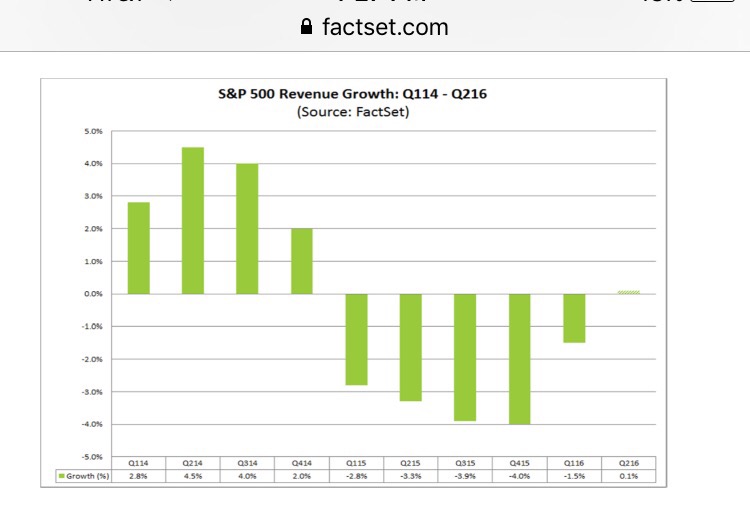
In addition, it looks like the 2nd quarter will mark the fifth straight quarter of declining corporate earnings. See pictures below. Yet, stocks hover near there all-time highs and prices relative to earnings are high on many broad measures. 

Yes, it’s confounding. So it has been in an extended era of extraordinarily low interest rate policy around the world.  


What Once Was Insane

July 15, 2016 by Jason P. Tank, CFA, CFP, EA

Back in 2009, I attended the annual meeting of Berkshire Hathaway, the conglomerate controlled by famed investor Warren Buffett. That year’s meeting held special attraction, taking place just weeks after the stock market hit its low during the financial crisis. Buffett served that day as investors’ North Star.

Prior to his much anticipated Q&A session, Buffett made a short presentation to a crowd of over 40,000 worried shareholders. His clear mission that morning was to calm and teach.

Buffett, in full professorial mode, highlighted a trade he made at the crisis-induced market low. In the midst of market panic, he had managed to sell a US government bond at a price that produced a negative yield for the buyer. Obviously, stuffing money under their mattress was just not a practical alternative.

Buffett’s lesson was clear. Investors had temporarily gone insane and rational behavior always returns.

Seven years have passed since his lecture and now trillions of dollars of government bonds across the globe trade at negative yields. Perversely, the US 10-year bond is now seen as attractive with its mouth-watering, positive yield of 1.5%.

What was once abnormal has become normal. Justifications abound. 
Central banks will hold rates low for much longer. Inflation is dead. Global growth is slow. As long as these conditions hold – and the cascade of consensus thinking says they will – yields will stay low or go lower.

The panicked investor Buffett once mocked is no longer. Interest rates at these absurd levels are now accepted as normal. There is no panic, but rather a cold calm about it all.

As the internet would transform the economy during the tech-stock bubble and the Fed-induced low interest rates justified ever-rising house prices and a credit bubble, what assumptions have we adopted as certain today?

Has Japan’s economic disease – following the bursting of their own credit bubble and marked by economic stagnation, demographic decline, persistent deflation and, yes, aggressive zero interest rate monetary policy – become investors’ new North Star?

The habit of real-time diagnosis is often a fool’s game in investing. Only in the aftermath of a burst bubble does a consensus narrative form.

Today, a new, dangerous consensus may be forming. With the justification and acceptance of insanely low interest rates across the globe – creating massive problems in meeting society’s future needs, such as pension and other retirement obligations – stocks are increasingly seen as the only alternative.

In the midst of a bubble, anchoring yourself to what you know can do wonders. While the chase for investment returns never ends, what I know is the desperate reach for returns never ends well.

Brexit and Inchworms

July 1, 2016 by Jason P. Tank, CFA, CFP, EA

A solid week has passed since British voters shocked the world with their decision to exit the European Union. This has given us some time to analyze the possible economic impacts of Brexit, as it is now known.

From an economic viewpoint, its ramifications on global growth are negative. When borders become more closed, impairing the flow of capital, decreasing access to workers and lowering trading opportunities, the impact on the economy is obvious. Just imagine if California or Texas or New York decided to secede from our union. It would affect not only the citizens of those states, but also people in Michigan and the rest of the world.

A growing and healthy economy lifts most people, to varying degrees. On the flipside, a stagnant and shrinking economy – a result much more likely after Brexit – disproportionately hurts people living on the lowest rungs of society’s economic ladder. Early voter analysis shows that poorer, less educated voters chose to leave Europe. Voting against one’s own economic interest is not a new phenomenon.

The vote to leave Europe was clearly based on non-economic reasons.

With the Brexit vote, the deciding factor hinged on issues of cultural sovereignty, rather than economic theory. Specifically, concerns of immigration policy played a serious role that tipped the balance.

Regardless of the motivations of the “leave” voters, the implications for the economy were indicated by the upheaval in financial markets. In part, the unprecedented decline of the pound sterling and stocks throughout Europe was a result of surprise. Unexpected events aren’t normally positive for financial markets. Nonetheless, the recovery in stock prices this past week could have been expected. Nothing moves in a straight line in capital markets.

However, the likely longer term effects can be visualized by watching an inchworm. The stuttering, stop-go nature of the economy’s forward progress can result in miscalculations along the way by businesses and investors. Those newly-launched expansion plans or that just-signed contract now face a different set of assumptions than originally planned. The global economy just became a bit more like an inchworm.

Looking forward, business confidence has also been impaired. Whether this hit to confidence is longer lasting will depend on how politicians throughout Europe and the UK handle the aftermath. Since the vote, uncertainty is heightened. In addition, the realities of the massive complexity of actually exiting the European Union hasn’t helped. It’s been aptly described as a messy divorce.

In my view, the Brexit vote has injected tangible uncertainty for businesses and markets, on a global scale. What affects the UK, affects the rest of Europe. And, what affects Europe, affects the US and Asia. With central bankers running out of policy bullets – with interest rates already at rock-bottom levels – and with global politics running on a potent mixture of anti-establishment and anti-globalization fuel, the situation will likely be uncomfortably volatile for investors.

In investing, discomfort can be a red flag or an opportunity. It is never easy to spot the difference.

Funny Charts Mean Little

June 15, 2016 by Jason P. Tank, CFA, CFP, EA

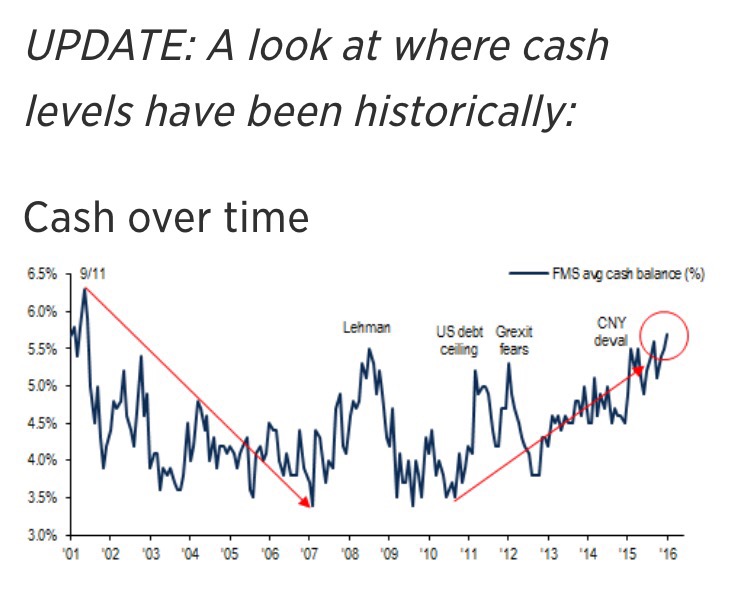
I found this chart to be kind of comical in the sense that it signifies almost nothing. Yet, it’s been cited by a big bank and it’s hit the CNBC newsfeed. Could a 2.5% swing in the level of current cash holdings in mutual funds mean all that much? Seems like an insignificant squiggly line to me. 

Who’s Afraid of a Fiduciary Duty?

June 10, 2016 by Jason P. Tank, CFA, CFP, EA

In this politically heated environment, yet another partisan battle ensues in Washington. It highlights a sad reality of how difficult it is to do what is so obviously right for consumers. In particular, the battle is over the concept that all investment advisors should adhere to a legal fiduciary duty to their clients when providing financial advice. Until very recently, this duty was largely followed by only a subset of financial professionals, registered investment advisors.

Viewed at a high-level, a fiduciary duty is simply the professional obligation to place the interests of the client first at all times and under all circumstances.

In many ways, the public’s ability to recognize a financial advisor acting as a fiduciary reminds me of that old legal definition of pornography – you know it when you see it. However, that doesn’t cut it when some in the financial services industry seem intent to blindfold the public. Amid a flurry of paperwork and small-print disclosures, most consumers are wholly ill-equipped and outgunned. That is precisely what industry regulation is designed to counter.

The quest to implore all financial advisors to operate under an obligation to act as fiduciaries has been the Holy Grail for as long as I can remember. Due to a massively powerful lobbying effort from those with a vested interest to avoid a legal obligation to first serve the interest of their customers, the foot-dragging among our regulators and politicians over the years was striking to watch. Finally, in April, the Obama administration took matters into its own hands.

Using the existing framework that imposes a fiduciary duty standard on financial advisors in their dealings with pension and employer-sponsored retirement plans, the Department of Labor simply expanded that same obligation to any professional who also provides advice to consumers who own an individual retirement account (IRA). In one fell swoop, that regulatory expansion brought almost every financial advisor into the fiduciary world. With a stroke of the executive branch’s pen, the last foot was dragged across the finish line.

Predictably and disappointingly, the House and the Senate – mostly along party lines -recently voted to strike down the new fiduciary duty rule. Obama’s veto last Wednesday successfully kept the rule in place.

In my view, despite the loss of a clear-cut competitive differentiator for me and my fellow registered investment advisors, the new fiduciary rule is a resounding victory for consumers. Let’s hope it survives our dysfunctional politics.

« Previous Page
Next Page »
  • Fee-Only
  • Fiduciary Duty
  • Risk Management
  • Financial Planning

© 2026 · Front Street Wealth Management | Form ADV | Privacy Policy | Disclosure